

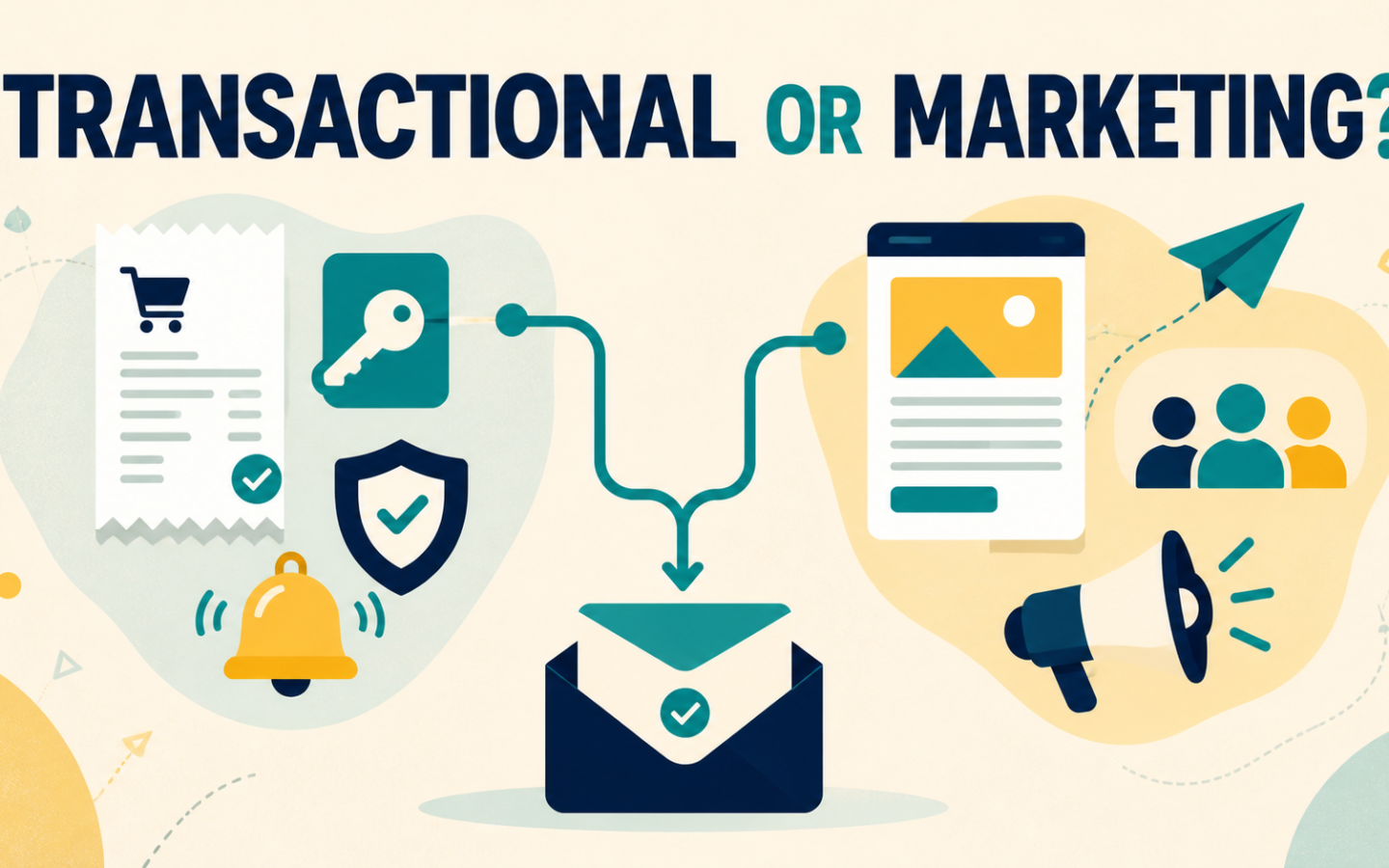
A customer resets a password and waits for the link. Another receives an invoice after a payment. Later that week, both receive your product newsletter.
All three messages arrive by email, but they do different jobs. The password reset and invoice help complete or explain an existing customer interaction. The newsletter is intended to create future interest or action. That difference affects the trigger, audience, content, consent process, sending method and measurement.
Transactional email vs marketing email is therefore not just a terminology debate. For South African businesses, correctly classifying each message helps teams design clearer customer communication, apply suitable POPIA-conscious processes and protect important operational mail from avoidable reputation problems.
What is the difference between transactional and marketing email?
Transactional email is normally triggered by a customer action, account event or service event and delivers information that the recipient needs or expects. Examples include a password-reset link, payment receipt, security alert or booking confirmation.
Marketing email is sent to promote, nurture, re-engage or encourage a future commercial action. Examples include newsletters, product promotions, event invitations and sales campaigns.
The most useful test is not whether the email was automated or sent to one person. Ask: Why is this message being sent, and what is its primary purpose? A message can be automated and still be marketing. A service update can be sent to thousands of customers and still be primarily operational. The content and context matter more than the button used to send it.
| Question | Transactional or operational email | Marketing email |
|---|---|---|
| What starts it? | A customer action, account event or service condition | A campaign plan, audience journey or commercial objective |
| What is its main job? | Confirm, secure, inform or complete an existing interaction | Promote, educate, nurture, retain or re-engage |
| Who receives it? | The affected person or relevant customer segment | A permission-aware subscriber or prospect audience |
| Typical timing | Immediately or when the event requires it | Scheduled or triggered according to a marketing journey |
| Typical sending route | Application, API, SMTP or event-driven automation | Campaign or marketing-automation workflow |
| Main measures | Speed, delivery, completion and support impact | Engagement, response, conversion and revenue |
Transactional email examples
A transactional message helps the recipient complete, confirm or understand something that has already happened. It should arrive promptly, identify the relevant account or action and make the next step unambiguous.
- Account access: password resets, verification links and security alerts.
- Payments: invoices, receipts, payment confirmations and failed-payment notices.
- Orders and bookings: order confirmations, collection notices, appointment confirmations and schedule changes.
- Product or service events: usage alerts, account-status changes and requested reports.
- Customer administration: changes to contact details, policy documents or an action the customer initiated.
A message does not become transactional merely because software sends it automatically. A birthday promotion or abandoned-cart sequence is automated, but its purpose is usually marketing. Conversely, a staff member can manually send an operational account update without turning it into a marketing message.
Marketing email examples
Marketing email is designed to create attention, consideration, engagement or a commercial response. The recipient may find it useful, but it is not required to complete the service they already requested.
- product and company newsletters;
- new-service announcements and promotional offers;
- educational nurture sequences;
- event, webinar and demo invitations;
- abandoned-cart or abandoned-enquiry follow-ups;
- customer win-back and re-engagement campaigns; and
- cross-sell, upsell and renewal campaigns with a promotional purpose.
Marketing does not have to mean a hard sell. A useful industry newsletter can still be direct marketing if its purpose is to promote the sender, its services or future commercial activity. The tone does not determine the category on its own.
Where do service notifications and customer updates fit?
Many NexaMail customers send a third group of messages that people casually call transactional: operational customer communication. These messages are not always triggered by an individual action, yet customers may need them to use a service or understand a change.
Examples include a network interruption notice from an ISP, a platform-status update from a SaaS company, a timetable change from a school, a candidate-status update from a recruiter or a billing-process change from a managed service provider.
Operational messages should be:
- sent only to the people affected;
- clear about the service, account or event involved;
- free from unnecessary promotional material;
- timed according to customer impact rather than a marketing calendar; and
- monitored for delivery and support response.
Do not use the “service notification” label to send promotions to people who have opted out of marketing. If the real purpose is to sell, re-engage or promote, manage it through the marketing process.
A practical classification matrix
| Message | Likely classification | Reason |
|---|---|---|
| Password-reset link | Transactional | The user requested it to regain account access. |
| Invoice or payment receipt | Transactional | It records or explains an account event. |
| Appointment reminder | Transactional or operational | It supports an existing booking when kept focused on that booking. |
| Unplanned service interruption | Operational | Affected customers need accurate service information. |
| Monthly product newsletter | Marketing | It nurtures interest and promotes the organisation or product. |
| Re-engagement sequence | Marketing | Its purpose is to prompt renewed activity. |
| Security alert containing an upgrade offer | Mixed purpose; review required | Promotion can distract from or change the character of an essential message. |
| Policy change plus unrelated promotion | Mixed purpose; separate the messages | The operational information and commercial offer serve different objectives. |
This matrix is a starting point, not a legal ruling. When a message carries legal, regulatory or contractual consequences, have the final classification and wording reviewed by the appropriate adviser.
Mixed-purpose email is where teams get into trouble
The grey area appears when an essential message also contains a promotion. A receipt includes an upgrade banner. A security alert advertises a premium package. A maintenance notice ends with a referral offer.
Before combining them, ask:
- Would we still send this message if the promotional block were removed?
- Can the recipient understand the essential information without seeing the offer?
- Is the commercial content secondary, or has it become the real reason for sending?
- Would the message still be appropriate for a customer who opted out of marketing?
The safer operational pattern is usually to keep essential communication focused and send the promotional material through the appropriate permission-aware marketing stream. That improves clarity for the customer and gives each message a clean objective to measure.
How POPIA affects the distinction
POPIA defines direct marketing around the purpose of promoting or offering goods or services, or requesting a donation. Section 69 addresses direct marketing by unsolicited electronic communication. The Information Regulator’s current Guidance Note on Direct Marketing explains how responsible parties should approach section 69 and related processing obligations.
This means “transactional” should not be treated as a magic legal switch. A genuine password reset has a different purpose from a promotion, but every organisation must still process personal information lawfully, collect only what it needs, protect it appropriately and respect applicable customer rights and preferences.
For marketing email, build a documented process that covers:
- how the contact was obtained and what they were told;
- the purpose and lawful basis for processing;
- consent or the relevant existing-customer conditions where applicable;
- identity and contact information in the message;
- a clear way to stop future marketing; and
- suppression so an opt-out is not reversed by a later import.
For operational and transactional messages, document why each message is necessary, limit its content to that purpose, restrict the audience to affected recipients and avoid slipping unrelated promotions into essential communication. See NexaMail’s guide to POPIA-conscious subscriber email for a broader operational checklist.
Should transactional and marketing email use the same infrastructure?
They can be managed by the same organisation or platform, but they should not be treated as one undifferentiated stream. Transactional messages are often time-sensitive: a password reset that arrives three hours late is technically delivered and practically useless. Marketing campaigns can create sudden volume and receive more unsubscribes or complaints.
Amazon SES recommends considering separate subdomains for marketing and transactional communication so each stream can develop a distinct reputation and one can be protected from problems in the other. The right design depends on sending volume, risk, systems and provider configuration; small senders do not automatically need dedicated IP addresses.
Use SMTP or an API for event-driven messages
An application commonly sends password resets, account alerts and receipts through SMTP or an email API when a system event occurs. The application passes the recipient, template data and event context to the sending service. Your team should monitor acceptance, bounces, delays and failures rather than assuming the application call proves delivery.
Use campaigns and automation for managed audience journeys
Newsletters, promotions and nurture sequences benefit from lists, segments, scheduling, consent records, unsubscribe processing and campaign reporting. Some operational updates also use campaign tools when a defined customer segment must receive the same service information.
Keep a shared suppression and preference strategy
Separating streams must not create conflicting customer records. Decide which preferences apply to marketing, which messages are operationally necessary, how complaints and invalid addresses are suppressed, and which system owns the current contact data. Do not let a person who opted out of a newsletter reappear simply because another system exported the address.
A five-question decision framework
Use this before creating any recurring email:
- What event or decision causes the message? A user action or service event points toward transactional or operational communication. A campaign objective points toward marketing.
- What would happen if the message were not sent? If the customer could not access, confirm or understand an existing service interaction, the message is likely operationally important.
- Who genuinely needs it? Choose the affected person or segment rather than defaulting to the entire database.
- What is the single primary action? Complete the reset, review the invoice, note the interruption, read the newsletter or consider the offer.
- Which sending and preference rules apply? Select the trigger, route, suppression, unsubscribe and monitoring process before writing the copy.
How different South African teams can apply this
ISPs, VoIP and managed IT providers
Keep network alerts, ticket updates and account notices concise and segmented by the affected service. Run newsletters, package promotions and referral campaigns through the marketing stream. Compare delivery with support volume: if an outage update was sent but calls still surged, the audience, timing or wording may need work.
SaaS businesses
Trigger verification, password, billing and usage messages from application events through SMTP or API. Use marketing automation for onboarding education, feature adoption and re-engagement. Decide carefully whether onboarding steps are necessary service instruction, promotional nurture or a combination that should be separated.
Recruitment and professional services
Candidate-status messages, appointment confirmations and requested documents support an existing interaction. Vacancy alerts, newsletters and service promotions are marketing. Segment by role, location, service interest and current relationship instead of broadcasting every opportunity to every contact.
Schools, churches and membership organisations
Administrative notices and programme changes serve a different purpose from fundraising appeals, event promotion and newsletters. Maintain clear lists and preferences so members understand why they receive each type of communication.
Where NexaMail fits
NexaMail supports the different ways a South African organisation needs to communicate: newsletters and campaigns for managed audiences, automation for recurring journeys, customer updates for affected segments, and API or SMTP connections for messages triggered by business systems.
The platform does not decide the legal purpose of a message for you. Your team still needs to define the trigger, audience, purpose, preference rule and response path. NexaMail provides a practical place to organise those workflows, monitor sending and scale volume without moving immediately to enterprise-priced software.
If you are mapping several message streams, discuss your customer communication workflow with the NexaMail team. If the structure is already clear, compare Rand-based NexaMail sending plans against your real monthly volume.
Frequently asked questions
What is transactional email?
Transactional email is normally sent because of a customer action, account event or service event and provides information the recipient needs or expects. Common examples are password resets, receipts, booking confirmations and security alerts.
What is marketing email?
Marketing email promotes, educates, nurtures, retains or re-engages an audience with the aim of encouraging future interest or action. Newsletters, product offers and win-back campaigns are common examples.
Is a newsletter transactional or marketing?
A general company, product or industry newsletter is normally marketing because its purpose is to nurture a relationship or promote future activity. Calling it an “update” does not change its purpose.
Are service notifications marketing email?
A focused message about an affected customer’s current service is usually operational rather than promotional. Keep the audience relevant and the content limited to the service information. If the message includes offers or unrelated promotion, review or separate that content.
Does POPIA allow transactional email?
POPIA does not provide a simple blanket rule based only on the label “transactional.” Consider the actual purpose, the personal information being processed and the applicable lawful-processing requirements. Section 69 specifically regulates direct marketing by unsolicited electronic communication. Obtain legal advice for high-risk or ambiguous use cases.
Do transactional emails need an unsubscribe link?
Do not rely on a universal yes-or-no rule detached from purpose and jurisdiction. Essential account messages and marketing subscriptions serve different functions. Provide appropriate preference controls, never use essential mail to bypass a marketing opt-out, and have your compliance process reviewed where necessary.
What is the difference between SMTP and transactional email?
SMTP is a technical protocol used to transfer email. Transactional describes the purpose and trigger of a message. SMTP can carry transactional, operational or marketing email, while transactional messages may also be submitted through an email API.
Can one platform handle transactional and marketing email?
Yes, provided the platform supports the required campaign, automation, SMTP or API workflows and the organisation keeps purpose, audiences, preferences, monitoring and reputation risks properly organised.
Map your email before you automate it
List every recurring message your organisation sends. For each one, record the trigger, primary purpose, audience, timing, action, sending route, preference rule and owner. The exercise exposes mixed-purpose emails, missing suppressions and important customer messages that currently depend on a staff member remembering to send them.
Once the map is clear, use NexaMail automation for suitable journeys, connect event-driven messages through API or SMTP, and keep campaigns and customer updates aligned with the audience that genuinely needs them.
Community discussion
Be the first to comment
Add a useful question or perspective. Comments are reviewed before publication.