

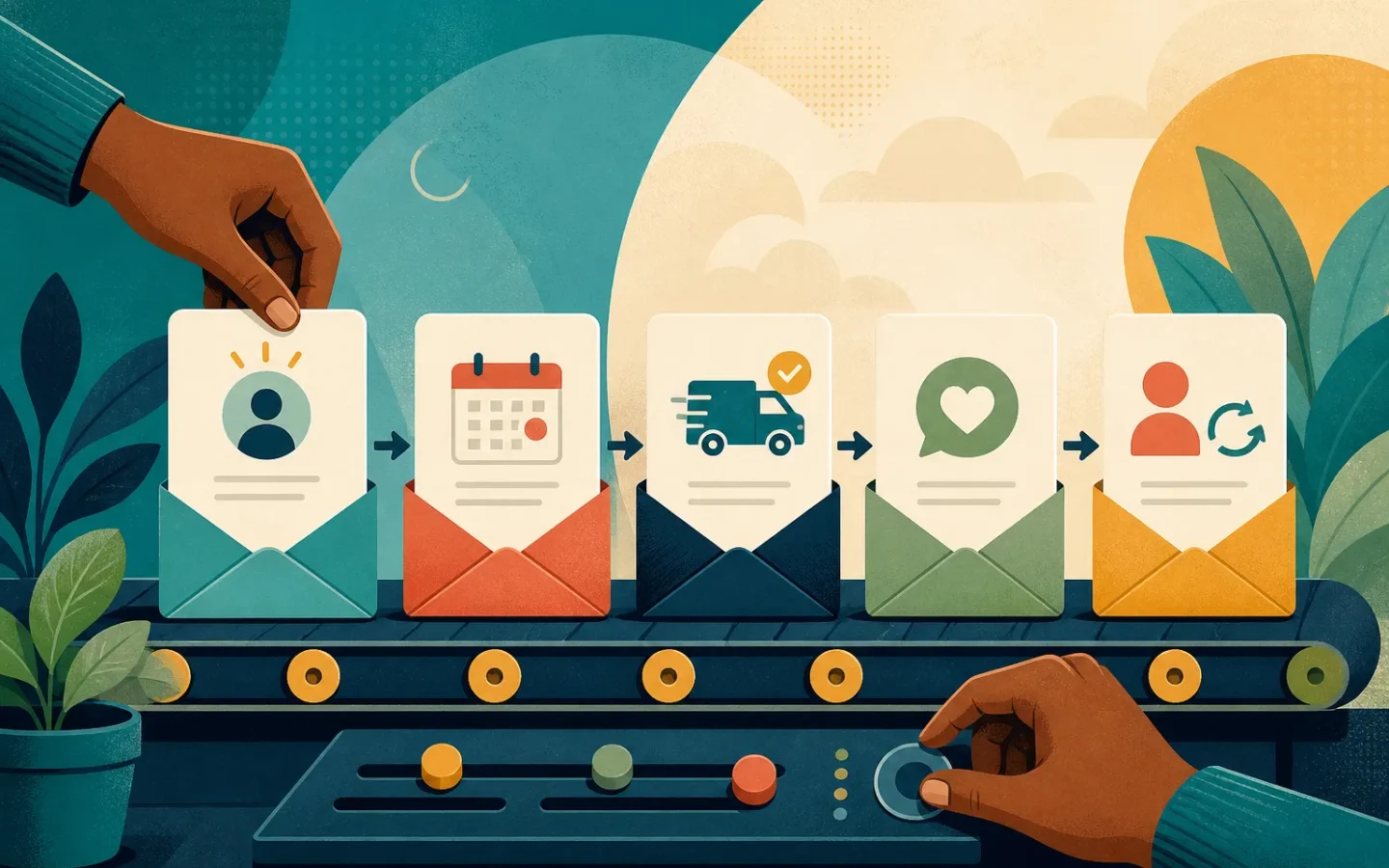
Automation only converts when it is built around customer decisions, not internal schedules.
If a subscriber downloads a guide, requests a quote, or abandons checkout, each action should trigger a focused workflow with one clear next step.
For South African teams, the goal is practical execution: launch a small set of high-impact journeys, align messaging to intent,
and keep POPIA controls embedded in every workflow.
What makes an automation workflow convert
- Behavior-based triggers instead of one-size broadcast timing.
- One decision per email and one clear CTA.
- Strong segment logic by lifecycle stage and intent.
- Suppression rules to prevent overlap and fatigue.
- Flow-level KPI tracking tied to commercial outcomes.
The five workflows that drive the most value
1. Welcome and qualification workflow
Trigger within minutes of signup. Confirm value quickly, set message expectations, and gather one qualification signal
such as business type, goal, or purchase timeline.
2. Lead nurture workflow
Use a structured sequence over two to four weeks. Move from education to proof and then conversion. Keep each email tightly scoped,
and match content to the subscriber’s intent level.
3. Abandoned intent recovery workflow
Recover high-intent contacts who drop before action completion. This includes abandoned carts, unfinished demos, or incomplete forms.
Use a staged timing model: first reminder fast, second reminder with value, third with urgency.
4. Post-purchase onboarding workflow
New customers need fast time-to-value. Use onboarding emails to guide activation milestones, remove early friction,
and open relevant upsell paths once core usage is established.
5. Re-engagement and cleanup workflow
Identify inactive contacts, run a structured reactivation attempt, then suppress records that remain unresponsive.
This protects sender reputation and keeps reporting accurate.
Workflows convert when they react to intent in real time, not when they follow a fixed calendar.
NexaMail Strategy Team
POPIA-ready workflow controls
Compliance should be part of workflow logic from day one. Keep consent source records, timestamped opt-ins, and instant unsubscribe handling.
For official local guidance, review the
Information Regulator South Africa.
- Check consent status before workflow entry.
- Use clear unsubscribe and preference controls in every promotional flow.
- Apply suppression rules globally so contacts do not receive overlapping sends.
- Audit consent and suppression logs monthly.
Execution framework: first 60 days
Days 1-20
- Audit form sources and consent records.
- Define lifecycle segments and naming conventions.
- Launch welcome and qualification workflow.
Days 21-40
- Launch nurture workflow for highest-intent channel.
- Deploy abandoned intent recovery workflow.
- Set baseline KPI reporting by workflow.
Days 41-60
- Add onboarding and re-engagement workflows.
- Run first A/B tests on subject and CTA clarity.
- Adjust timing and messaging by drop-off data.
Workflow KPI scoreboard
| Workflow | Primary KPI | Secondary KPI |
|---|---|---|
| Welcome + qualification | Qualified action rate | Time to first action |
| Lead nurture | Conversion rate | Revenue per recipient |
| Abandoned intent recovery | Recovered conversions | Recovery time |
| Post-purchase onboarding | Activation rate | Early churn reduction |
| Re-engagement | Reactivation rate | List health improvement |
Where NexaMail fits
You can implement this model with
Smart Automation,
Audience Management,
POPIA Compliance, and
Delivery Insights.
The focus should stay on fast execution, clean segmentation, and workflow-level optimization.
Frequently asked questions
Which workflow should South African teams launch first?
Launch the welcome and qualification workflow first. It captures fresh intent and improves downstream personalization.
How many workflows should an SME run initially?
Start with three to five core workflows and scale only after stable KPI tracking is in place.
Do POPIA requirements affect workflow design?
Yes. Consent validation, unsubscribe handling, and suppression logic should be built into all workflow entry and exit rules.
How long does it take to improve conversion rates?
Many teams see early engagement lift within two to four weeks, with stronger conversion gains after consistent optimization over 8 to 12 weeks.
What KPI should be monitored per workflow?
Track conversion rate by workflow, revenue per recipient, and where contacts drop out of each journey.
Can B2B and ecommerce use the same workflow model?
Yes. The workflow framework is shared, but timing, message angle, and conversion events should be adapted to each buying cycle.


Community discussion
Be the first to comment
Add a useful question or perspective. Comments are reviewed before publication.