

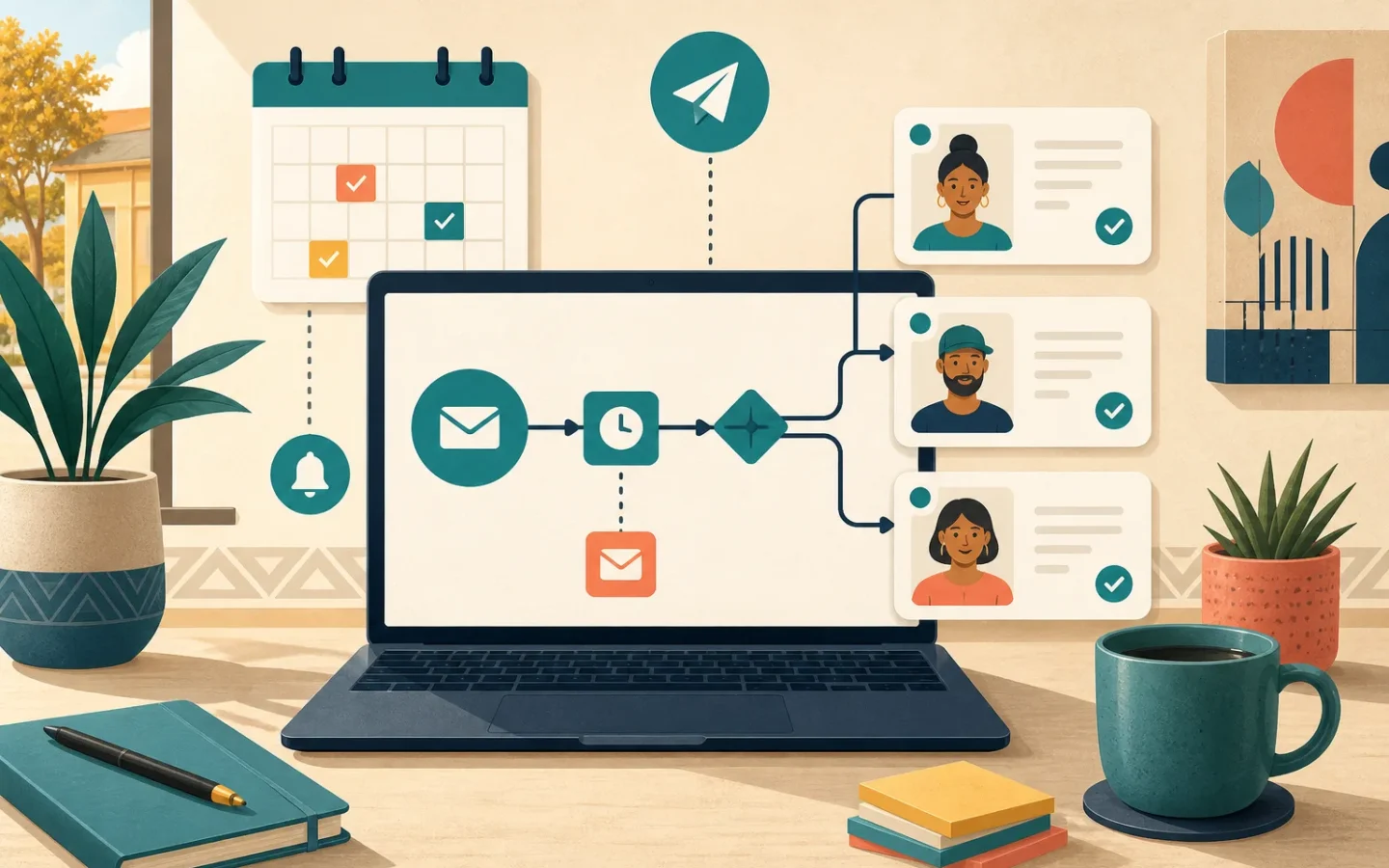
Many small businesses know they should automate email, but most implementations stall because teams attempt too much too early. The practical path is to start with a tight workflow set, clear ownership, and simple KPI tracking.
This guide focuses on execution. You will see what to build first, how to avoid common automation errors, and how to ensure every workflow contributes to measurable business outcomes.
Best Practice 1: Start with a workflow stack, not one-off campaigns
Small businesses should treat email automation as a connected stack. A campaign can create short-term spikes. A workflow stack creates compounding performance over time.
Core stack for small teams
- Welcome and qualification flow
- Lead nurture flow
- Abandoned intent or incomplete checkout flow
- Post-purchase onboarding flow
- Re-engagement flow
Best Practice 2: Build each flow around one decision
Each automated email should have one goal and one primary call to action. When teams try to push multiple actions in one message, click quality and conversion often drop.
Best Practice 3: Segment by intent, not only profile fields
A subscriber who visited pricing pages twice in three days should not receive the same messages as someone who only downloaded a top-of-funnel checklist. Intent segmentation improves relevance and protects send efficiency.
Recommended segmentation groups:
- New subscriber
- High-intent lead
- Active customer
- Inactive subscriber
Best Practice 4: Protect list health from day one
Small lists cannot absorb high complaint rates. Use explicit opt-in processes, remove invalid contacts quickly, and run re-engagement before full suppression. A clean list improves deliverability and lowers wasted send volume.
Best Practice 5: Use a monthly optimization rhythm
The highest-performing small teams use lightweight but consistent optimization cycles. Every month, review top flows, test one change at a time, and document wins.
| Review Cadence | What to Check | Action |
|---|---|---|
| Weekly | Bounces, unsubscribes, complaint trends | Fix list and sender issues fast |
| Monthly | Flow conversion and drop-off points | Test subject, CTA, timing |
| Quarterly | Full automation map relevance | Retire low-value sequences |
Best Practice 6: Keep compliance embedded in operations
Compliance should not be treated as a separate legal project. It needs to be part of workflow setup and list governance. If you market in South Africa, align every subscriber record with POPIA expectations and use clear preference controls.
See the dedicated compliance guide:
How to Stay POPIA Compliant When Emailing Subscribers.
A practical 60-day rollout for small businesses
Days 1-20
- Define lifecycle stages and segment rules.
- Set up welcome flow and baseline reporting.
- Audit form quality and source attribution.
Days 21-40
- Launch nurture and abandoned-intent workflows.
- Add simple lead scoring triggers.
- Implement suppression rules for low engagement.
Days 41-60
- Launch post-purchase onboarding flow.
- Run first round of A/B testing.
- Report ROI by workflow and optimize top performers.
Tools and pages to connect internally
- Smart Automation
- Audience Management
- Delivery Insights
- Email Marketing Trends in South Africa 2026
- Email Marketing vs Social Media in SA: ROI Comparison
Conclusion
Email automation best practices for small businesses are less about advanced tooling and more about operating discipline. Build focused workflows, maintain list quality, and optimize with consistent reporting. This gives small teams leverage without adding unnecessary complexity.
Frequently asked questions
What is the first automation a small business should build?
Start with a welcome and qualification flow.
How many automations should a small team manage initially?
Begin with three to five core workflows.
Can automation work without a large email list?
Yes, smaller lists often perform better when intent is high and segmentation is clear.
How often should workflows be reviewed?
Weekly health checks and monthly optimization are a practical baseline.
What metric matters most for small business automation?
Conversion rate per workflow and revenue generated per sequence.
Should every automated email include promotions?
No, educational and onboarding emails are critical to long-term retention.


Community discussion
Be the first to comment
Add a useful question or perspective. Comments are reviewed before publication.